
Coaching Through Frustration: How to Stay Steady With Players, Parents, and Yourself
Youth sports can test any coach—between player emotions, parent pressure, and the chaos of game days. This blog shares simple ways to manage frustration, stay calm, and keep your team learning and having fun.
4/14/20267 min read

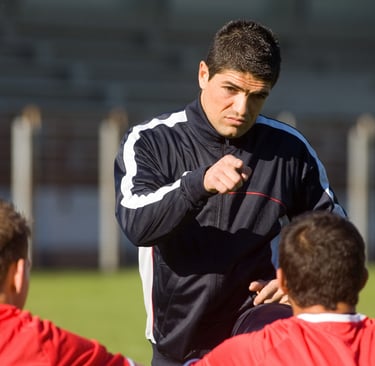
If you coach youth sports long enough, frustration isn’t a “maybe.” It’s a certainty.
You’re going to have days where the kids can’t stop talking during instructions. You’re going to have practices where it feels like nobody can catch, dribble, pass, or remember the one thing you just said ten seconds ago. You’re going to have games where the ref misses an obvious call, your team gets rattled, and suddenly you can feel the whole sideline tightening up. And yes—at some point—you’re going to have a parent interaction that makes you think, “Why am I doing this again?”
That’s not you failing. That’s coaching.
The real question isn’t how to avoid frustration. It’s how to handle it in a way that keeps you effective, keeps the kids learning, and keeps the season enjoyable—because the fastest way to burn out is letting frustration become your default coaching voice.
And it’s not your imagination that this is hard right now. A national survey that was covered by ESPN (connected to SafeSport reporting) highlighted that managing parents ranks among the top reasons youth coaches consider quitting. Another story citing those findings noted that a large chunk of coaches reported being verbally harassed, often by parents. That doesn’t mean parents are “the enemy.” It means youth sports is an emotional environment, and you’re the person standing in the middle of it.
So let’s talk about how to coach through frustration like someone who wants to stay in the game for a long time.
What frustration is actually telling you
Most coaching frustration isn’t random. It’s usually a signal that something is out of alignment.
Sometimes it’s your expectations versus what’s realistic for the age group. You want crisp execution, quick listening, and focus for 60 straight minutes… but you’re coaching nine-year-olds after a full day of school. That doesn’t mean standards shouldn’t exist. It just means your plan has to match how kids actually learn and behave.
Sometimes it’s the emotional load. Coaching youth sports isn’t only teaching fundamentals. It’s managing a group of kids with different skill levels and different attention spans, keeping practice moving, addressing conflicts, communicating with parents, setting lineups, and being the calm adult even when you’re tired. When coaches feel like they have to carry everything alone, frustration builds faster because there’s no release valve.
And sometimes it’s uncertainty in the environment. If your team doesn’t know what the standards are, what the boundaries are, or what happens when something goes wrong, you’ll spend a season reacting to the same issues over and over. That reaction cycle is exhausting, and it makes every little problem feel bigger than it needs to be.
When you start seeing frustration as information—not a personal failure—you can respond smarter. Instead of “I’m mad,” you start thinking, “What’s missing here: clarity, structure, or support?”
That shift alone will change how you coach.
Frustration with players: keep the moment small, coach the skill, move on
Players will frustrate you. Not because they’re trying to. Because kids are inconsistent by definition.
They forget what you taught last week. They get distracted. They talk when you’re talking. They try something goofy in a drill and it ruins the rep. They melt down after mistakes. They blame teammates. They get dramatic. They shut down. They go full superhero mode and ignore everything you said.
Your job isn’t to eliminate kid behavior. Your job is to shape it.
The biggest mistake coaches make in these moments is treating frustration like disrespect. Sometimes it is. Most of the time, it’s just immaturity plus emotion plus stimulation. And the more you interpret it as disrespect, the more personal your response becomes. That’s when coaches escalate, and once you escalate, the kids escalate too.
Here’s the alternative: keep the moment small.
When a kid is frustrated—after a missed shot, a bad pass, an error, a strikeout—the emotion is real, but the best coaching response is usually simple and repeatable. You’re not trying to “win the argument.” You’re trying to get them back to learning.
That can sound like: “I get it. Quick reset. Next rep.” Or, “That one stung. Breathe. Eyes up.” Short. Calm. Forward-moving.
This is where positive coaching isn’t “soft coaching.” It’s effective coaching. SafeSport’s resources on positive coaching emphasize supportive approaches that help athletes build confidence and create healthier sport experiences. When you respond in a way that de-escalates instead of embarrasses, the kid gets back in the game faster—and the rest of the team stays focused too.
The other key: coach behaviors, not emotions.
You don’t have to scold a kid for being upset. You do need to coach what happens next. If their body language drops, you coach body language. If they slam a bat, you coach equipment safety. If they blame teammates, you coach teammate standards. The emotion can exist. The behavior still has a standard.
Over time, what kids really learn from you is not whether you “allow feelings.” They learn whether they can make mistakes without being shamed—and whether there’s a consistent expectation for how they respond afterward. That’s a life skill disguised as sports.
Frustration with parents: boundaries are kindness (and they protect everyone)
Parent frustration is tricky because it’s rarely about you as a person. It’s about their kid.
Parents can be reasonable, supportive, and appreciative… and still have moments where they’re anxious, protective, or overly invested. Especially when playing time changes, roles shift, or a kid has a tough stretch. And if you don’t have a structure for parent communication, you’ll end up dealing with that anxiety in the least productive way possible: in the heat of the moment.
This is where frustration grows, because you start feeling like you’re being “attacked” for volunteering your time. Then you get defensive. Then parents get more emotional. And now the whole relationship turns into tension.
You don’t fix this with more arguing. You fix it by creating predictability.
The first part is setting expectations early. Not a long manifesto. Just a simple, clear message: how you communicate, when you communicate, and what is appropriate on the sideline. A big source of coach stress is when parents treat games like a second coaching staff meeting—yelling instructions, second-guessing decisions, or trying to process emotions right after a loss.
There’s data behind what coaches feel. Liberty Mutual’s youth sports sportsmanship survey has reported high levels of sideline “coaching” and negative behavior, including parents yelling at officials and kids. When that’s happening, it doesn’t just frustrate coaches—it creates a stressful environment for the kids.
The second part is teaching the framework behind your decisions. Most parent frustration comes from uncertainty. If parents don’t understand what you prioritize—effort, coachability, attitude, teamwork—they’ll assume playing time and roles are random or political. Even if they’re wrong, perception becomes reality fast.
So you don’t need to justify every lineup decision. But you do want to communicate the “how decisions get made” philosophy early in the season. Parents may not love every outcome, but they will respect consistency and clarity more than silence.
The final part is protecting the “24-hour rule.” Postgame conversations are emotional. Kids are emotional. Parents are emotional. Coaches are tired. That’s not the time for hard conversations. When you set a boundary like “playing time questions happen the next day,” you’re not being cold—you’re preventing the worst version of everyone from showing up at the same time.
And yes, parent management is a real driver of burnout. That ESPN/SafeSport coverage makes that clear. If you want to coach long-term, boundaries aren’t optional. They’re part of your self-preservation plan.
Frustration with yourself: the hidden load that burns coaches out
This part doesn’t get said enough, especially to volunteer and parent-coaches:
Coaching is emotionally expensive.
You’re thinking about practice plans, behavior, team culture, fairness, safety, development, and parent communication… while also dealing with work, family, and your own stress. When everything piles up, the smallest thing—one kid goofing off, one parent comment, one bad stretch in a game—can feel ten times bigger than it should.
This is where coaches get stuck: they start taking everything personally. The team’s performance feels like a reflection of them. A kid’s lack of focus feels like disrespect. A parent’s question feels like accusation. And now every problem carries emotional weight.
That’s a straight path to burnout.
Burnout isn’t just “being tired.” It’s emotional fatigue, reduced satisfaction, cynicism, and withdrawal—feeling like you’re giving a lot and getting nothing back. Athletic training organizations discuss burnout as a real concern in sport environments. If you want to keep coaching—and enjoy it—you need a way to unload the emotional weight.
A simple strategy is separating your role from your identity.
Your job is to control inputs: preparation, teaching, tone, consistency, and culture. Your job is not to control whether nine-year-olds execute perfectly or whether a ref gets every call right. When you focus on inputs, frustration becomes feedback. When you focus on outcomes, frustration becomes anger.
Another underrated habit is a post-practice reset. Not a huge journal. Just a quick mental closeout: what went well, what you’ll adjust next time, and one thing you handled well as a coach. That’s how you keep one tough practice from becoming a week-long emotional loop in your head.
The moment-of-truth skill: how to keep yourself from snapping
Every coach has that moment where they feel the heat rising.
You’re about to say something sharper than necessary. You’re about to “make an example” out of a kid. You’re about to argue with a parent or an official. You’re about to coach from emotion instead of intention.
Here’s the simplest, most effective tool you can use:
Give yourself three seconds.
That tiny pause is the difference between leadership and reaction.
In those three seconds, decide what your goal is. Not “get it out of my system.” Your goal is usually one of three things: restore order, teach the skill, or protect the environment. Once you know the goal, your response gets cleaner.
You can correct firmly without being loud. You can hold a standard without humiliation. You can redirect without drama. And you can walk away from an adult conversation that is happening at the wrong time.
That’s not weakness. That’s composure. And composure is contagious.
